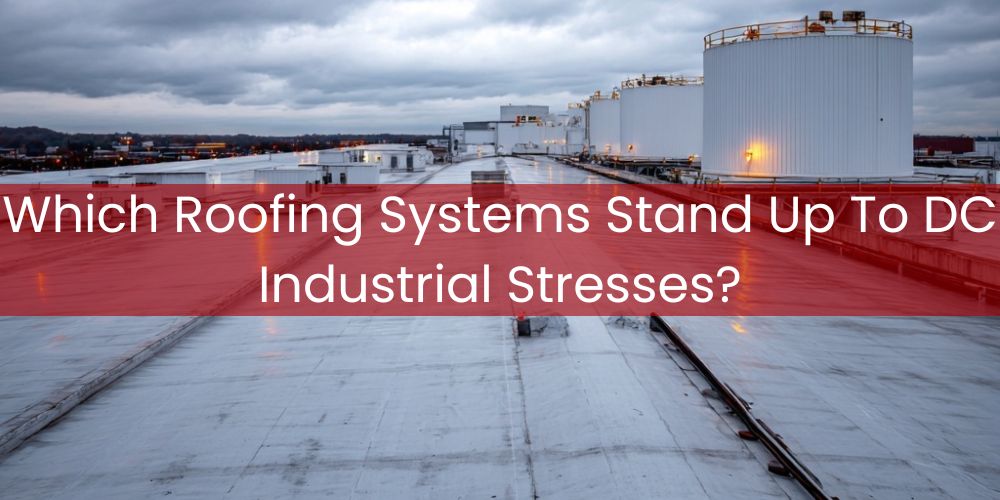
In Washington, DC, industrial roofing systems like EPDM, TPO and PVC are known for their durability and resistance to industrial stresses such as chemical exposure and temperature fluctuations. DC's diverse climate, with its hot summers and cold winters, necessitates roofing systems that can withstand significant thermal expansion and contraction. Additionally, the industrial environments in DC often involve exposure to chemicals and pollutants, making EPDM's synthetic rubber composition and TPO's heat-welded seams ideal to maintain structural integrity and waterproofing. For commercial property owners and facility managers in Washington, DC, understanding which roofing systems can withstand industrial stresses is crucial for ensuring longevity and reducing maintenance costs.
Commercial Roofing Washington DC provides professional industrial roofing services for facilities across Washington DC and the Mid-Atlantic region. Industrial buildings often require roofing systems that can withstand heavy use, support large roof spans, accommodate rooftop equipment, and perform reliably under demanding environmental conditions. Our services are tailored to the needs of industrial properties such as warehouses, manufacturing facilities, and distribution centers, with a focus on durability, moisture control, and long-term performance. From preventative maintenance and repairs to full system replacements, we deliver roofing solutions designed to protect industrial operations and support uninterrupted productivity. Below, we’ll delve into the performance of different roofing materials, discussing their key advantages and optimal applications for DC's unique industrial landscape.
What Unique Industrial Stresses Do Commercial Roofs Face In Washington, DC?
Commercial and industrial roofs in Washington, DC operate in a uniquely demanding environment shaped by pronounced seasonal temperature swings, persistent urban construction activity, high traffic-related pollution, and strict building performance expectations. Unlike lower-density markets, DC’s dense urban footprint exposes roofing systems to continuous external stressors that accelerate membrane fatigue, compromise drainage performance, and shorten service life if not properly engineered.
Roofs in this region must withstand freeze–thaw cycling in winter, prolonged heat and humidity in summer, elevated rooftop debris loads from surrounding development, and chemical exposure from airborne pollutants. At the same time, many commercial buildings in DC face energy-efficiency targets, regulatory oversight, and limited access for repairs, making failures more costly and more disruptive. These conditions require roofing systems that are not only weather-resistant, but specifically designed for urban industrial stress, thermal movement, and long-term durability, supported by disciplined inspection and maintenance planning.
- Wide temperature swings and freeze–thaw cycling
- Urban construction debris and rooftop contamination
- Air pollution and chemical exposure
- Persistent moisture and drainage stress
- Heat gain and energy performance demands
1. Wide temperature swings and freeze–thaw cycling
Washington, DC’s climate subjects commercial roofs to significant thermal movement throughout the year. Summer temperatures routinely drive roof surface temperatures far beyond ambient air levels, while winter conditions introduce prolonged cold and repeated freezing events. This constant expansion and contraction places stress on seams, laps, fasteners, and termination details. When moisture enters minor defects and freezes, it expands within the roof assembly, gradually separating membrane layers, loosening fasteners, and degrading insulation. Over time, this cycling leads to seam failure, loss of adhesion, and accelerated material fatigue unless the roof system is specifically designed to accommodate thermal movement and resist moisture intrusion.
2. Urban construction debris and rooftop contamination
DC’s dense urban environment and near-constant construction activity expose commercial roofs to elevated levels of abrasive debris, dust, and airborne particulates. These materials settle across roof surfaces and concentrate around drains, scuppers, mechanical units, and penetrations. Accumulated debris restricts drainage pathways, increasing the likelihood of ponding water and localized loading. In addition, abrasive particulates can wear protective surfacing, coatings, and membranes, particularly on high-traffic or wind-exposed rooftops. Without routine cleaning and inspection, debris buildup becomes a direct contributor to leaks, membrane breakdown, and premature roof failure.
3. Air pollution and chemical exposure
High vehicle traffic, urban emissions, and industrial activity subject roofs in Washington, DC to continuous exposure from airborne pollutants. These contaminants can settle onto roofing surfaces and react chemically with membranes, coatings, and sealants. Over time, this exposure accelerates oxidation, reduces material flexibility, and weakens protective layers, particularly on aging roofs or systems without protective coatings. Chemical degradation often occurs gradually and invisibly, shortening the effective service life of the roof and increasing susceptibility to cracking, splitting, and moisture penetration.
4. Persistent moisture and drainage stress
Frequent rainfall and elevated humidity levels place ongoing stress on waterproofing systems and roof drainage design. Even well-constructed roofs can become vulnerable if drainage components are undersized, obstructed, or improperly sloped. Standing water increases hydrostatic pressure on seams and penetrations, while prolonged moisture exposure can saturate insulation and compromise thermal performance. High humidity further contributes to condensation risk within roof assemblies, promoting microbial growth and material deterioration. Effective drainage design, consistent maintenance, and prompt repair are essential to prevent moisture-related failures in DC’s climate.
5. Heat gain and energy performance demands
Extended periods of summer heat and intense solar exposure significantly increase thermal loading on commercial roofs in Washington, DC. Elevated surface temperatures accelerate material aging, reduce membrane elasticity, and amplify thermal movement stresses. At the building level, excessive heat gain drives higher cooling demand and energy costs, particularly in large commercial and industrial facilities. Reflective membranes, cool roof systems, and protective coatings are often necessary to lower surface temperatures, reduce heat transfer into the building envelope, and maintain compliance with modern energy performance expectations.
Have a question about an upcoming project?
How Do Different Commercial Roofing Materials Perform Under DC-Specific Conditions?
Washington, DC places commercial roofing systems under sustained stress from aggressive thermal cycling, prolonged moisture exposure, airborne pollutants, rooftop debris accumulation, and elevated summer heat loads. These conditions do not cause immediate failure; instead, they accelerate specific, predictable breakdown points within each roofing system. Long-term performance in DC depends on how well a roof manages movement, resists moisture under pressure, and protects vulnerable details over time.
- TPO single-ply roofing
- PVC single-ply roofing
- Modified bitumen roofing
- Built-up roofing (BUR)
- Commercial metal roofing
- Roof coatings and restoration systems
1. TPO single-ply roofing
TPO is widely used in DC due to its reflectivity and cost efficiency, but its performance is highly dependent on installation quality and ongoing maintenance. The membrane itself tolerates heat well, yet DC’s freeze–thaw cycles place repeated stress on seams, corners, penetrations, and perimeter details. As the roof expands in summer and contracts in winter, poorly welded seams or thin membranes are prone to gradual separation. In DC, TPO failures most commonly occur at field seams, pipe boots, mechanical curbs, and termination bars, particularly where moisture intrusion allows freeze expansion beneath the membrane. Long-term success requires thicker membranes, reinforced details, disciplined drain maintenance, and periodic seam inspections to prevent progressive failure.
2. PVC single-ply roofing
PVC generally outperforms TPO in DC’s urban environment due to its superior resistance to chemical exposure, grease, and airborne pollutants. Traffic exhaust, industrial emissions, and rooftop contaminants have less impact on PVC’s flexibility and chemical stability over time. This makes PVC particularly well suited for buildings near major roads, dense commercial corridors, and facilities with rooftop mechanical discharge. Under DC’s thermal cycling, PVC maintains seam integrity better than many alternatives when properly heat-welded. Failures are less frequent but tend to be more localized, typically involving poor flashing transitions or aging plasticizers in older systems. While higher in upfront cost, PVC often delivers longer service life in DC when pollution exposure and long-term durability are primary concerns.
3. Modified bitumen roofing
Modified bitumen performs reliably in DC because its multi-layer construction provides redundancy against moisture intrusion and physical stress. It tolerates freeze–thaw cycling well, particularly when reinforced with polyester or fiberglass and surfaced appropriately. The system’s thickness helps absorb movement and resist puncture from debris common in dense urban environments. However, modified bitumen is sensitive to chronic ponding water, which is common in DC where debris blocks drains or roof slopes are marginal. Over time, standing water accelerates surface breakdown, seam fatigue, and granule loss. Modified bitumen systems in DC perform best when drainage is actively managed and periodic resurfacing is planned as part of the roof’s lifecycle.
4. Built-up roofing (BUR)
BUR systems remain one of the most durable options under DC’s combination of moisture, temperature swings, and mechanical stress. Multiple plies create strong resistance to water infiltration and provide thermal mass that dampens rapid temperature changes. This makes BUR particularly resilient against freeze–thaw damage and slow-developing leaks. The primary vulnerability of BUR in DC is weight and drainage sensitivity. Without adequate slope and drain capacity, ponding water can persist long enough to saturate insulation and degrade asphalt layers. BUR roofs perform best on structures designed to support their weight and where drainage has been engineered and maintained with long-term water management in mind.
5. Commercial metal roofing
Metal roofing excels in DC’s environment when thermal movement is properly accounted for. It resists pollution, UV exposure, debris impact, and moisture far better than membrane systems. However, DC’s wide seasonal temperature swings cause significant expansion and contraction, which places stress on fasteners, clips, seams, and panel transitions. Failures typically occur not in the panels themselves, but at fastener back-out, seam separation, flashing fatigue, and penetrations that restrict movement. When engineered with floating clips, proper expansion detailing, and high-quality sealants, metal roofing offers exceptional longevity in DC, particularly for industrial and institutional facilities.
6. Roof coatings and restoration systems
Roof coatings are frequently used in DC to manage heat gain, protect aging membranes, and extend service life without full replacement. Silicone coatings perform well under standing water conditions common in urban settings, while acrylic and elastomeric coatings improve reflectivity and UV resistance. However, coatings do not correct structural or drainage deficiencies. In DC, coating failures almost always trace back to underlying moisture intrusion, saturated insulation, or unresolved ponding issues. When applied to a dry, stable roof with functioning drainage, coatings can meaningfully slow environmental degradation and reduce thermal stress.
Which Roofing Systems Offer The Best Long-Term Solutions For DC Industrial Buildings?
For industrial buildings in Washington, DC, long-term roofing success is determined less by advertised features and more by how effectively a system manages thermal movement, prolonged moisture exposure, urban contamination, and realistic maintenance conditions over decades of service. Roofs that perform best in this market are those designed to tolerate environmental stress continuously, rather than relying on ideal conditions or frequent corrective intervention.
- Single-ply membrane systems (EPDM, TPO, PVC)
- Multi-layer systems (modified bitumen and BUR)
- Metal roofing systems
1. Single-Ply Membrane Systems (EPDM, TPO, PVC)
Single-ply membranes dominate DC’s industrial roofing landscape because they accommodate thermal movement efficiently and adapt well to large roof areas with complex penetrations and mechanical equipment. EPDM remains a strong long-term option where flexibility and movement tolerance are critical, particularly on expansive roofs with relatively simple detailing. Its ability to absorb seasonal expansion and contraction makes it well suited to DC’s freeze–thaw conditions. TPO and PVC systems add the advantage of high solar reflectivity, helping to control heat gain during DC’s long, humid summers and reduce cooling demand. Between the two, PVC typically delivers the longest service life in dense urban environments due to its superior resistance to chemical exposure, grease, and airborne pollutants. TPO provides a more cost-efficient alternative, but long-term performance in DC depends heavily on membrane thickness, seam integrity, and disciplined installation at penetrations and terminations.
2. Multi-Layer Systems (Modified Bitumen and BUR)
Modified bitumen and built-up roofing systems continue to perform well on DC industrial buildings where durability, redundancy, and impact resistance are priorities. Their layered construction provides inherent protection against moisture intrusion, mechanical wear, and gradual environmental degradation. These systems are particularly effective on facilities exposed to frequent foot traffic, rooftop equipment servicing, and debris accumulation from surrounding urban activity. The primary limitations are weight and sensitivity to drainage design. Without adequate slope and clear drainage paths, ponding water can shorten service life. When structural capacity, slope, and drainage are properly engineered, multi-layer systems offer exceptional longevity under DC’s demanding moisture and temperature conditions.
3. Metal Roofing Systems
Metal roofing provides one of the longest potential service lives for industrial buildings in Washington, DC when thermal movement is properly engineered into the system. Metal panels resist UV exposure, airborne pollution, debris impact, and long-term moisture far better than most membrane systems. However, DC’s wide seasonal temperature swings create significant expansion and contraction forces that must be accommodated through correct clip systems, fastener detailing, and flexible flashing assemblies. Failures typically occur at restrained penetrations, poorly detailed seams, or rigid transitions that prevent movement. When these risks are properly addressed, metal roofing offers outstanding durability and minimal long-term degradation, making it well suited to industrial facilities where longevity and reduced lifecycle disruption outweigh higher upfront investment.
Need Industrial Roofing Services in Washington DC or the Mid-Atlantic?
Industrial facilities depend on dependable roofing systems to protect equipment, inventory, and operations. Our industrial roofing services are designed to meet the performance and durability demands of industrial buildings throughout Washington DC and the Mid-Atlantic region. Contact Commercial Roofing Washington DC today to discuss industrial roofing services for facilities across Washington DC and the Mid-Atlantic region.