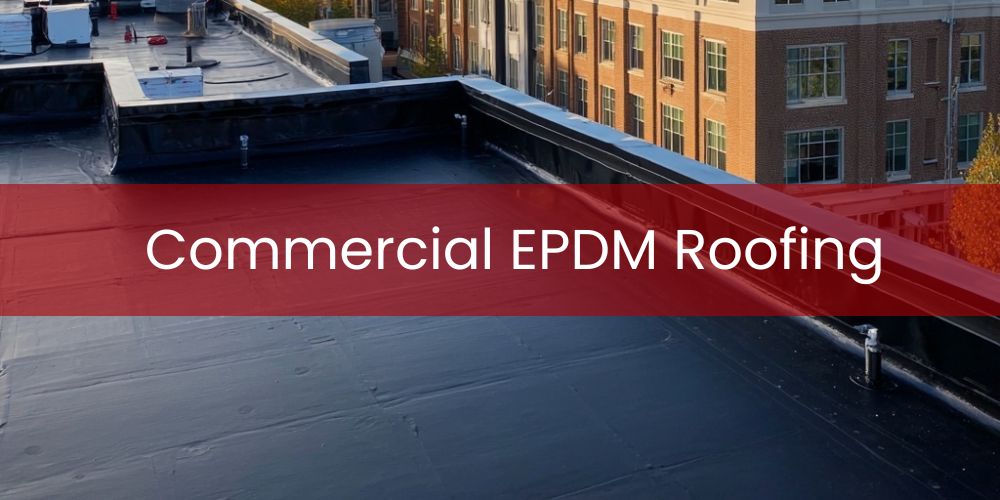
Commercial EPDM roofing is a single-ply rubber roofing system designed for flat and low-slope commercial buildings, valued for its flexibility, durability, and resistance to weather extremes. It performs reliably under thermal movement, prolonged moisture exposure, and long service cycles, making it a proven solution for long-term commercial roof protection. Commercial Roofing Washington DC provides commercial EPDM roofing services throughout Washington DC.
In Washington DC, commercial EPDM roofing provides flexible performance due to its ability to withstand the region's varied weather conditions, ranging from hot, humid summers to cold, icy winters. EPDM roofing is particularly beneficial in DC's climatic environment because it remains durable and flexible across a wide temperature range, reducing the risk of cracks and leaks. Its excellent resistance to UV radiation and ozone ensures that the roofing material maintains its integrity, even with the high-sun exposure seen in DC summers. For commercial building owners and facility managers in Washington DC, understanding the advantages of EPDM roofing is key to ensuring long-term durability and energy efficiency of their properties. Below, we’ll explore the detailed benefits and performance characteristics of commercial EPDM roofing in DC’s unique climate conditions.
What Makes EPDM Roofing a Practical Choice for Commercial Buildings in Washington DC?
EPDM roofing is a practical choice for commercial buildings in Washington DC because it delivers consistent waterproofing performance, long service life, and predictable maintenance behavior under the city’s demanding climate conditions. DC commercial roofs are exposed to hot, humid summers, cold winters, heavy rainfall, and repeated freeze–thaw cycles, all of which accelerate failure in rigid or brittle systems. EPDM’s flexibility, chemical stability, and repairability allow it to perform reliably on flat and low-slope commercial roofs when properly installed and maintained. The following factors explain why EPDM remains a widely specified commercial roofing system in Washington DC.
- Weather Resistance: Performs Reliably Through DC’s Seasonal Extremes
- Durability: Long Service Life on Flat and Low-Slope Commercial Roofs
- Energy Performance: Stable Thermal Behavior With Optional Reflective Strategies
- Cost Control: Predictable Installation and Maintenance Economics
- Sustainability Considerations: Long Lifespan and Recyclability
1. Weather Resistance: Performs Reliably Through DC’s Seasonal Extremes
Weather resistance refers to a roofing system’s ability to remain watertight, flexible, and structurally stable despite prolonged exposure to rain, wind, temperature swings, and ultraviolet radiation. In Washington DC, commercial roofs are subjected to extended rain events, wind-driven storms, snow accumulation, freeze–thaw cycles, and intense summer heat, often within the same year. EPDM’s synthetic rubber formulation remains flexible across a wide temperature range, allowing the membrane to absorb expansion and contraction without cracking, splitting, or losing adhesion. This elasticity significantly reduces stress at seams, penetrations, perimeter terminations, and flashing details, which are the most common failure points on commercial roofs in DC. As a result, EPDM maintains consistent waterproofing performance even as environmental conditions fluctuate sharply between seasons, making it well suited to the region’s unpredictable weather patterns.
2. Durability: Long Service Life on Flat and Low-Slope Commercial Roofs
Durability refers to a roofing system’s ability to resist material breakdown while delivering consistent performance over decades of service. EPDM has one of the longest proven track records in commercial roofing, with many systems in Washington DC exceeding 25 to 30 years when properly installed and maintained. This longevity is particularly valuable in DC, where commercial roof replacement costs are elevated due to labor rates, permitting requirements, disposal fees, and limited urban access. EPDM’s resistance to ozone exposure, ultraviolet radiation, and thermal fatigue allows it to age slowly and predictably rather than experiencing sudden membrane failure. Instead of widespread degradation, EPDM systems typically show gradual wear that can be addressed through localized repairs, extending usable life and reducing lifecycle disruption. This makes EPDM especially attractive for commercial buildings where reliability and long-term planning outweigh short-term material trends.
3. Energy Performance: Stable Thermal Behavior With Adaptable Design Options
Energy performance refers to how a roofing system influences heat transfer, rooftop temperatures, and HVAC demand within a commercial building. Standard EPDM membranes are typically black, which increases heat absorption during Washington DC summers but can provide beneficial passive heat gain during colder months. In DC commercial applications, EPDM systems are often paired with higher R-value insulation, ballast assemblies, or reflective coatings to balance seasonal energy demands and meet building performance goals. While EPDM does not offer inherent reflectivity like TPO or PVC, its thermal behavior is predictable and adaptable based on roof assembly design rather than membrane color alone. This allows building owners and designers to tailor energy performance to occupancy patterns, interior loads, and mechanical systems. For many commercial properties, especially those with year-round occupancy, this controlled thermal response can support efficient energy management when properly engineered.
4. Cost Control: Predictable Installation and Long-Term Maintenance Economics
Cost control refers to managing both upfront installation expense and long-term ownership costs without sacrificing performance reliability. EPDM remains one of the most financially predictable commercial roofing systems in Washington DC due to widespread contractor familiarity, readily available materials, and straightforward installation methods. Large sheet sizes reduce seam density, lowering both installation time and long-term leak risk compared to systems with frequent welded or bonded seams. When damage does occur, EPDM repairs are typically simple, localized, and do not require specialized heat-welding equipment, allowing for faster response and lower repair costs. For DC building owners managing capital budgets, multi-property portfolios, or occupied buildings where disruption must be minimized, EPDM provides stable lifecycle economics rather than chasing the lowest upfront price at the expense of long-term maintenance exposure.
5. Sustainability Considerations: Long Lifespan and Reduced Replacement Frequency
Environmental impact refers to a roofing system’s material efficiency, service life, and end-of-life handling over the full building lifecycle. EPDM membranes are recyclable and benefit from long service life, which significantly reduces the frequency of tear-offs, material disposal, and construction waste generation. In Washington DC, where sustainability reporting, emissions reduction initiatives, and lifecycle assessments increasingly influence commercial property decisions, longevity itself becomes a meaningful environmental advantage. Fewer roof replacements over the life of a building translate into reduced raw material consumption, lower landfill volumes, and less disruption to building occupants and surrounding neighborhoods. For long-term property owners, EPDM’s durability directly supports improved lifecycle sustainability outcomes rather than relying solely on short-term energy metrics.
Have a question about an upcoming project?
How Does EPDM Roofing Respond to Washington DC’s Weather and Environmental Stress?
EPDM roofing responds effectively to Washington DC’s weather and environmental stress by maintaining flexibility, waterproofing integrity, and material stability under repeated exposure to temperature extremes, heavy precipitation, and long-term ultraviolet radiation. DC’s climate places sustained pressure on commercial roofing systems through hot, humid summers, cold winters, frequent rain events, and freeze–thaw cycles that accelerate membrane fatigue and seam failure. EPDM’s elastomeric composition and proven commercial track record allow it to absorb these stresses without the brittle cracking or rapid degradation seen in less flexible systems.
- Resistance to Thermal Cycling and Seasonal Temperature Swings
- Performance During Prolonged Rainfall and Freeze–Thaw Conditions
- Ultraviolet and Ozone Resistance Under Summer Sun Exposure
- Adaptability to Moisture, Humidity, and Vapor Pressure
- Long-Term Reliability Under Urban Environmental Load
1. Resistance to Thermal Cycling and Seasonal Temperature Swings
Thermal cycling refers to the repeated expansion and contraction of roofing materials caused by daily temperature shifts and seasonal extremes. Washington DC experiences prolonged summer heat with high solar loading followed by winter conditions that routinely fall below freezing, creating constant movement stress on flat and low-slope commercial roofs. EPDM’s elastomeric rubber composition allows it to remain flexible across a wide temperature range, enabling the membrane to move with the roof structure rather than resisting that movement. This flexibility significantly reduces stress at seams, penetrations, parapet transitions, and perimeter terminations, which are the most common failure points on DC commercial roofs. By absorbing thermal movement instead of cracking or splitting under stress, EPDM helps maintain continuous waterproofing performance through repeated seasonal cycles.
2. Performance During Prolonged Rainfall and Freeze–Thaw Conditions
Environmental stress in Washington DC frequently involves extended rainfall followed by sudden temperature drops that create freeze–thaw cycles. These conditions are especially demanding on commercial roofs, where low slope, rooftop equipment, and drainage constraints can allow water to remain on the surface longer than intended. EPDM provides continuous waterproofing that resists water intrusion even during prolonged saturation. Unlike rigid membranes that stiffen and fracture when temperatures fall, EPDM maintains elasticity in cold weather, allowing seams and flashing details to remain sealed as trapped moisture freezes and expands. This resistance to freeze–thaw damage is critical in DC, where winter leak events often originate from materials that lose flexibility under cold, wet conditions.
3. Ultraviolet and Ozone Resistance Under Summer Sun Exposure
Ultraviolet radiation and atmospheric ozone are major drivers of long-term membrane degradation on exposed commercial roofs. Washington DC’s long summer days, urban heat island effect, and elevated rooftop temperatures significantly increase cumulative UV exposure across large roof surfaces. EPDM is inherently resistant to both ultraviolet radiation and ozone due to its stable polymer structure, eliminating reliance on surface-applied coatings that can wear away or degrade over time. This built-in resistance slows oxidation, prevents surface embrittlement, and allows the membrane to retain elasticity for decades. As a result, EPDM roofs in DC tend to age gradually and predictably, rather than experiencing rapid surface breakdown that leads to premature leaks or membrane failure.
4. Adaptability to Moisture, Humidity, and Vapor Pressure
Washington DC’s humid subtropical climate introduces persistent moisture challenges, including elevated ambient humidity and vapor pressure differentials between conditioned interior spaces and the exterior environment. These conditions can accelerate blistering, delamination, and material breakdown in roofing systems that are sensitive to moisture. EPDM’s low water absorption rate and chemically stable structure limit moisture-related degradation within the membrane itself. When properly paired with insulation, vapor control layers, and appropriate detailing, EPDM systems perform reliably in environments where humidity and vapor drive place continuous stress on the roof assembly. This makes EPDM particularly well suited for DC commercial buildings with high occupancy levels and year-round interior climate control.
5. Long-Term Reliability Under Urban Environmental Load
Environmental stress on commercial roofs in Washington DC extends beyond weather exposure alone. Rooftop HVAC equipment, mechanical vibration, routine maintenance traffic, and airborne urban pollutants all contribute to gradual system fatigue over time. EPDM’s toughness and repairability allow it to tolerate these cumulative stresses without sudden, system-wide failure. When localized damage does occur, EPDM can be repaired through targeted patching or seam reinforcement without disturbing the broader roof assembly. This incremental repair capability enables DC commercial property owners and facility managers to control maintenance costs, address wear proactively, and extend roof service life without the operational disruption and capital expense associated with premature replacement.
When Is EPDM Roofing the Right Choice for Commercial Buildings in Washington DC?
EPDM roofing is the right choice for commercial buildings in Washington DC when long-term durability, predictable performance, and controlled lifecycle costs are prioritized over maximum reflectivity or specialty chemical resistance. DC’s mix of flat and low-slope commercial roofs, seasonal temperature extremes, frequent rainfall, and high replacement costs makes EPDM particularly well suited for buildings that require flexibility, repairability, and extended service life. EPDM performs best on properties where roof drainage is functional, rooftop access is routine, and owners intend to hold or operate the building long term rather than pursue short-term resale. The following conditions typically indicate when EPDM is an appropriate and strategic commercial roofing choice in Washington DC.
- Flat and Low-Slope Commercial Roofs With Proven Drainage Design
- Buildings Requiring Long-Term Durability and Predictable Aging
- Properties With Budget-Conscious Lifecycle Cost Priorities
- Commercial Roofs With Frequent Maintenance Access and Repair Needs
- Owner-Occupied or Long-Held Buildings Prioritizing Longevity Over Initial Cost
1. Flat and Low-Slope Commercial Roofs Requiring Long-Term Flexibility
Flat and low-slope commercial roofs require long-term flexibility to accommodate structural movement without membrane failure. In Washington DC, seasonal temperature swings cause roof decks to expand during hot summers and contract during cold winters, creating repeated stress on roofing systems. EPDM’s elastomeric rubber composition allows the membrane to stretch and recover with this movement rather than resisting it. This reduces cracking, seam fatigue, and perimeter separation that commonly occur on more rigid roofing materials. For DC commercial buildings with large roof spans and minimal slope, EPDM provides reliable performance under constant thermal cycling.
2. Buildings Exposed to Frequent Rainfall and Freeze–Thaw Conditions
Buildings exposed to frequent rainfall and freeze–thaw cycles require roofing systems that remain watertight in both wet and freezing conditions. Washington DC regularly experiences extended rain events followed by sudden temperature drops, especially during fall and winter. On low-slope commercial roofs, water often remains present when freezing occurs, placing extreme stress on seams and penetrations. EPDM maintains flexibility in cold weather, allowing seals to remain intact during freeze–thaw expansion that causes rigid membranes to crack. This makes EPDM a dependable choice for DC commercial roofs where water exposure and freezing conditions overlap.
3. Commercial Properties Requiring Predictable Lifecycle Costs
Commercial properties requiring predictable lifecycle costs benefit from roofing systems with stable aging and straightforward repairability. In Washington DC, roofing costs are heavily influenced by labor rates, access constraints, and permitting requirements, making emergency repairs and premature replacement especially expensive. EPDM ages slowly and predictably, reducing the likelihood of sudden system-wide failures. When damage does occur, repairs are typically localized, inexpensive, and minimally disruptive. This cost predictability makes EPDM well suited for DC property owners managing long-term budgets or multiple commercial assets.
4. Roofs With Moderate Foot Traffic and Mechanical Penetrations
Roofs with moderate foot traffic and mechanical penetrations require membranes that tolerate movement and localized stress without tearing. Many Washington DC commercial buildings have rooftop HVAC units, telecom equipment, and exhaust systems that require frequent service access. EPDM performs well around penetrations because it can flex without splitting and can be easily reinforced at high-stress areas. Walk paths, patches, and flashing details integrate well with EPDM systems without compromising overall integrity. This makes EPDM a practical solution for operational commercial buildings where rooftop access is unavoidable.
5. Long-Term Owners Prioritizing Reliability Over Short-Term Energy Gains
Long-term owners prioritizing reliability over short-term energy gains benefit from EPDM’s durability and environmental stability. While EPDM is not inherently reflective like TPO or PVC, its resistance to UV radiation, ozone exposure, and thermal fatigue supports decades of consistent performance. In Washington DC, where insulation quality and roof longevity often have a greater impact on lifecycle cost than reflectivity alone, EPDM can be paired with insulation upgrades or coatings when energy performance is a concern. Its slow aging profile reduces replacement risk and maintenance volatility. For owner-occupied or long-hold commercial properties, EPDM delivers dependable performance with controlled long-term risk.
Need Help With Commercial EPDM Roofing In Washington DC?
If your roof is actively leaking, showing age-related wear, or struggling through DC’s seasonal temperature swings, now is the time to take action before small issues become major disruptions. If you are unsure whether EPDM is the right solution or simply want an expert opinion on your roof’s current condition, a professional assessment can clarify your options without pressure. And if you want guidance, planning support, or a clear path forward for repair, restoration, or replacement, our team is here to help you make a confident, informed decision that protects your building long term.