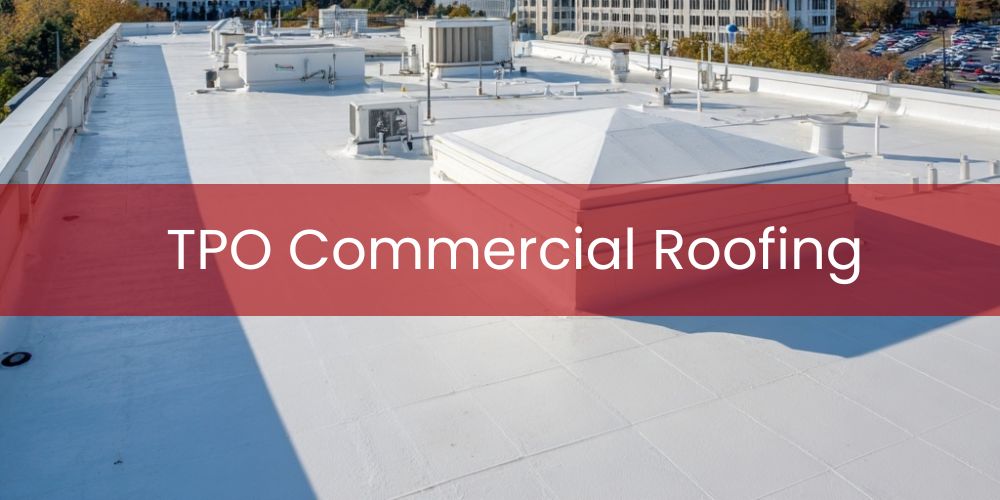
TPO commercial roofing is a single-ply thermoplastic membrane system widely used on flat and low-slope commercial buildings for its balance of durability, energy efficiency, and cost control. It is particularly effective in urban environments like Washington DC, where roofs must manage heat, rainfall, wind exposure, and long-term operational demands without excessive maintenance. Commercial Roofing Washington DC provides TPO commercial roofing services throughout Washington DC, delivering installation, replacement, and long-term performance solutions tailored to offices, warehouses, retail buildings, government facilities, and multi-tenant commercial properties.
TPO commercial roofing in Washington DC delivers high energy efficiency and weather resistance across various roof types, making it a reliable choice for reducing heating and cooling costs in the area’s variable climate. Washington DC experiences a mix of hot, humid summers and cold, snowy winters, which can challenge the performance of many roofing materials. TPO roofing offers excellent UV resistance and flexibility, maintaining durability on flat and low-slope roofs commonly found on commercial buildings in the city. For commercial building owners and facility managers in Washington DC, understanding the performance of TPO roofing across different roof types is essential for ensuring long-term protection and cost savings. In this blog, we'll analyze how TPO roofing performs in DC’s climate conditions, compare its effectiveness to other roofing options, and provide insights into maximizing your roof's lifespan.
What Makes TPO Roofing a Popular Choice for Commercial Buildings in Washington DC?
TPO roofing is a popular choice for commercial buildings in Washington DC because it balances energy performance, installation efficiency, and long-term durability under the city’s specific climate and regulatory conditions. DC’s hot summers, freeze–thaw winters, frequent rainfall, and dense urban construction environment place unique demands on commercial roofing systems. TPO performs well in this context by delivering reliable waterproofing, strong seam integrity, and measurable energy benefits while remaining cost-competitive for large roof areas.
- Energy Efficiency: Reflective membranes reduce cooling demand during DC summers.
- Durability: Engineered membranes withstand DC’s seasonal weather stress and rooftop activity.
- Cost-Effectiveness: Competitive installation costs and predictable lifecycle performance.
- Environmental Benefits: Supports sustainability and compliance requirements in DC.
- Seam Integrity: Heat-welded seams reduce leak risk in heavy rainfall conditions.
1. Energy Efficiency: Reflective membranes reduce cooling demand during DC summers.
Energy efficiency in TPO roofing refers to the membrane’s ability to reflect solar radiation and limit heat transfer into the building. In Washington DC, prolonged summer heat combined with high humidity places sustained load on commercial HVAC systems, particularly in large footprint buildings with extensive roof area. White and light-colored TPO membranes maintain high solar reflectance values over time, reducing rooftop surface temperatures and limiting heat gain through the roof assembly. This directly lowers cooling demand, stabilizes interior temperatures, and reduces peak energy consumption during DC heat waves. Over the lifespan of the roof, these reductions translate into measurable operating cost savings and improved compliance with local energy performance benchmarks.
2. Durability: Engineered membranes withstand DC’s seasonal weather stress and rooftop activity.
Durability refers to a roofing system’s ability to perform reliably under repeated environmental, thermal, and mechanical stress. Commercial roofs in Washington DC are exposed to freeze–thaw cycles, heavy rainfall, wind uplift during storms, and routine rooftop foot traffic for mechanical servicing. TPO membranes are reinforced and heat-welded at seams, creating uniform joints that resist separation under wind pressure and thermal movement. The material retains flexibility across temperature ranges common in DC, reducing the risk of cracking or seam fatigue over time. When properly detailed at edges, penetrations, and terminations, TPO systems maintain structural and waterproofing performance even under frequent rooftop access and seasonal stress.
3. Cost-Effectiveness: Competitive installation costs and predictable lifecycle performance.
Cost-effectiveness considers both upfront installation expense and long-term ownership costs. In Washington DC, commercial roofing projects often face elevated labor costs, logistical constraints, and permitting requirements that increase total project spend. TPO membranes are lightweight, available in wide sheets, and installed using heat welding, which accelerates installation and reduces labor hours compared to multi-layer systems. Over its service life, TPO typically requires fewer repairs when seams are properly welded and drainage is maintained. Predictable maintenance requirements, combined with energy savings and reduced material complexity, make TPO a financially practical option for DC property owners managing large or occupied commercial buildings.
4. Environmental Benefits: Supports sustainability and compliance requirements in DC.
Environmental benefits refer to reduced environmental impact during installation, operation, and eventual roof replacement. TPO membranes are recyclable and manufactured without plasticizers that migrate or rapidly degrade, contributing to longer material stability. In Washington DC, where sustainability initiatives, ESG reporting, and green building standards influence commercial development, TPO aligns well with regulatory and corporate environmental goals. Its high reflectivity helps reduce urban heat island effects, a growing concern in dense DC neighborhoods. For property owners seeking to balance performance with sustainability compliance, TPO offers a roofing solution that supports both operational efficiency and environmental responsibility.
5. Seam Integrity: Heat-welded seams reduce leak risk in heavy rainfall conditions.
Seam integrity refers to the strength and reliability of membrane joints under water exposure and movement. Washington DC experiences frequent rainfall events that place continuous stress on roof seams, particularly on low-slope commercial systems. TPO seams are heat-welded to form a fused joint rather than relying on adhesives or tapes, creating a bond that is often stronger than the membrane itself. This significantly reduces the likelihood of seam separation under hydrostatic pressure or wind-driven rain. Strong seam integrity addresses one of the most common failure points in commercial roofing and is a key reason TPO performs well in DC’s wet and storm-prone climate.
Have a question about an upcoming project?
How Does TPO Compare to Other Commercial Roofing Materials in Terms of Performance in Washington DC?
TPO roofing performance in Washington DC is best evaluated by how it handles heat, moisture, storms, installation constraints, and long-term operating costs compared to EPDM, PVC, metal, and modified bitumen systems. DC’s humid summers, frequent rainfall, freeze–thaw cycles, and dense urban construction environment place specific demands on commercial roofing systems. The following performance factors explain where TPO excels relative to other common commercial roofing materials in the region.
- Energy Efficiency: Superior solar reflectivity compared to EPDM and modified bitumen.
- Durability: Strong resistance to DC’s thermal cycling and storm conditions.
- Cost-Effectiveness: Lower installed cost than PVC and metal with predictable lifecycle expense.
- Environmental Performance: Better sustainability profile than traditional asphalt-based systems.
- Installation Efficiency: Faster and more adaptable than metal and multi-layer systems in urban DC sites.
1. Energy Efficiency: Superior solar reflectivity compared to EPDM and modified bitumen.
Energy efficiency refers to a roofing system’s ability to limit heat gain and reduce cooling demand within a building. TPO membranes are manufactured with highly reflective white surfaces that significantly outperform traditional EPDM and dark modified bitumen roofs in Washington DC’s hot, humid summers. By reflecting a large portion of solar radiation, TPO lowers rooftop surface temperatures and reduces heat transfer into the building envelope. This directly decreases HVAC runtime during peak summer months, which is especially important for large commercial buildings with high internal loads. While PVC offers similar reflectivity, TPO typically delivers comparable energy performance at a lower material and installation cost, making it a practical balance of efficiency, performance, and budget control for DC property owners.
2. Durability: Strong resistance to DC’s thermal cycling and storm conditions.
Durability refers to a roof’s ability to maintain waterproofing and structural performance under repeated environmental stress. In Washington DC, commercial roofs experience aggressive thermal cycling, expanding in summer heat and contracting in winter cold, combined with frequent storms and wind uplift. TPO membranes are designed with heat-welded seams that form continuous, fused joints, providing superior resistance to seam separation compared to EPDM’s taped seams. TPO also offers greater flexibility and impact resistance than many modified bitumen systems, which can become brittle over time. While metal roofs deliver exceptional longevity, they require complex detailing to manage expansion and noise, making TPO a more adaptable and resilient solution for dense urban commercial environments.
3. Cost-Effectiveness: Lower installed cost than PVC and metal with predictable lifecycle expense.
Cost-effectiveness measures both the initial installation cost and the total cost of ownership over the roof’s service life. In Washington DC, where labor rates, permitting requirements, and logistical constraints drive up construction costs, TPO’s lightweight rolls and streamlined installation process significantly reduce labor hours. Unlike multi-layer modified bitumen or structurally demanding metal systems, TPO installs quickly with fewer components and fewer trade dependencies. While PVC may offer enhanced chemical resistance in specific industrial settings, its higher material cost often exceeds the practical needs of most DC commercial buildings. TPO delivers consistent performance, manageable maintenance requirements, and predictable long-term costs, making it one of the most financially efficient commercial roofing options in the region.
4. Environmental Performance: Better sustainability profile than traditional asphalt-based systems.
Environmental performance refers to a roofing system’s impact during installation, operation, and end-of-life disposal. TPO membranes are recyclable and do not rely on asphalt compounds or migrating plasticizers that degrade and shorten service life, unlike modified bitumen systems. In Washington DC, where energy benchmarking, ESG reporting, and sustainability mandates increasingly influence commercial real estate decisions, TPO aligns well with environmental compliance goals. Its reflective surface helps reduce urban heat island effects, which is a growing concern in dense DC neighborhoods. Although metal roofing is also recyclable, its higher embodied energy and installation complexity often make TPO the more practical sustainability solution for large-scale commercial roofs.
5. Installation Efficiency: Faster and more adaptable than metal and multi-layer systems in urban DC sites.
Installation efficiency refers to the speed, adaptability, and reliability of a roofing system during construction. Washington DC commercial properties frequently face limited staging space, restricted access, noise considerations, and fully occupied buildings that cannot tolerate prolonged disruption. TPO’s single-ply design, wide sheet widths, and heat-welded seams allow rapid installation with minimal tear-off and fewer trades involved. Compared to modified bitumen, TPO requires fewer layers and less equipment, and compared to metal, it avoids structural reinforcement and complex expansion detailing. When compared to EPDM, TPO’s welded seams provide superior long-term watertightness, allowing faster installation without sacrificing durability or leak resistance.
When Is TPO Roofing the Right Choice for Commercial Buildings in Washington DC?
TPO roofing is the right choice when a Washington DC commercial building needs a reflective, heat-welded single-ply system that installs efficiently on low-slope roofs while holding up to DC’s summer heat, heavy rain cycles, and routine rooftop foot traffic. It is most appropriate when the project priorities are balancing energy performance, reliable seam integrity, and predictable lifecycle cost without stepping up to the higher material cost of PVC or the added detailing complexity of metal.
- Flat and Low-Slope Commercial Roofs With High Cooling Demand
- Commercial Properties Requiring Cost Control Without Sacrificing Performance
- Buildings With Frequent Rooftop Access and Equipment Penetrations
- Projects With Energy Compliance, Benchmarking, or Sustainability Requirements
- Roofs That Do Not Require Extreme Chemical or Ponding Resistance
1. Flat and Low-Slope Commercial Roofs With High Cooling Demand
Flat and low-slope commercial roofs with high cooling demand are ideal candidates for TPO roofing because large, uninterrupted roof areas are the primary drivers of heat gain in commercial buildings. In Washington DC, offices, distribution centers, schools, medical facilities, and government buildings often have expansive roof surfaces that absorb solar radiation for prolonged periods during hot, humid summers. This heat transfer increases rooftop temperatures and places sustained strain on HVAC systems serving large interior volumes. TPO’s highly reflective membrane significantly reduces surface temperatures and limits heat transmission into the building envelope. Over time, this reduction in cooling demand translates into measurable energy savings, lower peak load stress on mechanical systems, and improved operational efficiency across large commercial spaces.
2. Commercial Properties Requiring Cost Control Without Sacrificing Performance
Commercial properties that require cost control without sacrificing performance benefit from TPO roofing due to its balance of installation efficiency, durability, and predictable lifecycle costs. In Washington DC, commercial roofing budgets are heavily influenced by elevated labor rates, permitting complexity, disposal costs, and constrained staging in dense urban environments. TPO’s single-ply construction, wide sheet rolls, and heat-welded seams allow faster installation than multi-layer modified bitumen systems, reducing labor hours and site disruption. At the same time, TPO delivers consistent waterproofing performance and seam strength when properly installed. This makes it a practical solution for property owners, portfolio managers, and public entities that need reliable performance while maintaining strict capital expenditure controls.
3. Buildings With Frequent Rooftop Access and Equipment Penetrations
Commercial buildings with frequent rooftop access and numerous mechanical penetrations are well suited to TPO roofing due to its seam strength and tolerance for routine foot traffic. In Washington DC, many commercial roofs support HVAC units, telecom equipment, exhaust systems, and regular maintenance activity, particularly on office buildings, hospitals, and institutional facilities. TPO membranes are heat-welded at seams, creating fused joints that resist separation under movement and localized stress. When detailed correctly around curbs, penetrations, and walk paths, TPO systems handle routine access more reliably than older adhered or taped membrane systems. This reduces the likelihood of seam-related leaks developing over time due to service activity.
4. Projects With Energy Compliance, Benchmarking, or Sustainability Requirements
Projects subject to energy compliance, benchmarking, or sustainability requirements often benefit from TPO roofing because of its contribution to reduced cooling loads and improved energy performance metrics. Washington DC enforces increasingly stringent energy benchmarking, emissions reporting, and building performance standards for commercial properties. TPO’s reflective surface helps lower building energy consumption during peak cooling periods, which can positively impact ENERGY STAR scores and compliance reporting. Additionally, TPO membranes are recyclable and do not rely on asphalt, aligning with sustainability and ESG objectives without introducing the higher structural loads or installation complexity associated with some alternative systems. This makes TPO a practical option for owners balancing regulatory compliance with constructability.
5. Commercial roofs That Do Not Require Extreme Chemical or Chronic Ponding Resistance
Commercial roofs which do not require extreme chemical resistance or chronic ponding tolerance are strong candidates for TPO roofing when drainage performance is functional and exposure conditions are typical. TPO performs reliably under normal rainfall patterns common in Washington DC, provided water dissipates within reasonable timeframes after storms. However, buildings with constant grease exhaust, aggressive chemical exposure, or long-term standing water may require PVC or silicone-based systems. For most DC commercial roofs with adequate slope, functioning drains, and controlled rooftop conditions, TPO delivers dependable waterproofing and durability without the added cost of membranes designed for more extreme environments.
Need Help With Commercial TPO Roofing In Washington DC?
If you already know your roof is nearing the end of its service life, are evaluating whether TPO is the right system for your building, or simply want expert guidance before committing to a major decision, Commercial Roofing Washington DC can help. We work with property owners, facility managers, and asset planners who need clear answers, not sales pressure, combining detailed roof assessments with practical recommendations based on budget, building use, and long-term performance goals. Whether you are ready to move forward or still weighing options, Commercial Roofing Washington DC provides the expertise, transparency, and execution needed to protect your commercial property with confidence.